Back to How to Use AI to Help, Not Hinder, Your Learning
Motivation
Topic Outcomes
Explain the role of motivation in learning, and how AI can help, not hinder, motivation.
Topic Summary
Vignette
Dr. Vasquez teaches an undergraduate class in the Gender Studies program called “Women in American Society”. She is concerned about some of her students. Several of the latest essays that were turned in were obviously generated by an AI chatbot without any original thought from the student. Some students just didn’t turn in the essay, and she is worried about whether they will be able to stay caught up in class. She asked her TA, Ahmed, to reach out informally to some of these students to find out what was going on.
Ahmed reports back that Martina admitted to using ChatGPT because she just wasn’t really interested in the topic and had other assignments she was trying to complete at the same time. Greg admitted to using Co-Pilot to write the essay and said that they are not comfortable with writing and just don’t know how to get their thoughts out in academic text. Louisa had not turned in the essay because she works full-time and had a sick child at home. She had done the reading and outlined her essay but had not had the chance to draft it yet. Dr. Vasquez wonders how she can help her students like Martina, Greg, and Louisa to use generative AI to help, not hinder their learning.
The Problem
Generative AI chatbots burst onto the scene with widespread adoption at the end of 2022, surprising many people with their ability to generate a variety of types of text that are generally indiscernible from human-written text. Some students have found that AI chatbots make it so much easier to cheat, while other students are afraid that AI will ruin our lives and want nothing to do with it. It’s unlikely that schools will be able to prevent students from using AI in their learning and effective use of AI chatbots is fast becoming a requirement in many occupations, so it is important that teachers and students alike learn how AI can help the learning process and when it should be avoided because it disrupts the learning process.
Motivation
Aspects of Learning In general, AI should not be used to do the work of the learning objective. If the goal of a learning task was to use well-written prose to describe an important event in your life, then asking ChatGPT to write this for you would not only be unethical, but it would cheat you out of the learning experience. The goal was to improve your writing ability and generative AI did that work instead. However, if the goal of the learning activity was for you to understand the interplay of factors that brought the Cold War to an end, then asking an AI chatbot to help you think through the various events and situations can actually be useful in helping you meet this goal. If you do the work of understanding and explaining the end of the Cold War with the help of generative AI, then you are doing the work of the learning objective. If writing skill is not the objective of the learning activity, then generative AI can be helpful in providing you feedback on your writing or ways of phrasing your ideas about the end of the Cold War that may make them clearer to the reader. Further resources for distinguishing appropriate use of AI for learning are presented by Ditch that Textbook and Kate Meyer.
In order to determine when it is appropriate to use generative AI for your learning, it is first important to understand how learning happens. In this section, we will explore some of the most important components of your learning journey: motivation and the formation and retention of knowledge. Each section will provide examples of how you can use generative AI to help and not hinder these aspects of learning.
What is it and how does it work?
Why do you do the things you do? Some things you do without thinking too much about them because they are habits or automated, like the procedure for riding a bike. Some things you plan ahead for and go on autopilot because they are part of your routine, like riding the subway to campus. Most of the rest of your actions are either a reaction to a trigger or are things you choose to do for a reason. This reason is your motivation. Motivation also sustains your actions toward achieving a goal. Interestingly, success at a task, like learning, increases your motivation for completing similar tasks. So, even if you don’t feel like learning about something, by forcing yourself to get started, you might grow the motivation you need to continue.
You may have heard of extrinsic motivation, where you choose to complete a task for an external reward, such as a grade or money, and intrinsic motivation, which stems from internal rewards like satisfaction and personal growth. Researchers have defined and studied motivation in several ways, but we will unpack one of these models here so you can see how AI can help or hinder your motivation for learning.
According to the Situated Expectancy Value Theory (SEVT) by Eccles and Wigfield (2020), our motivation is determined by contextual and situational factors, like social identity, background, and previous experience, as well as goals and academic self-concept, or what you believe about yourself in terms of learning. These all influence the key determinants of motivation: expectations for success (ES) and subjective task values (STV). Your choices and performance all return to feed your previous experiences, goals, and academic self-concept, influencing further motivation (see Figure 1). Let’s explore this in a little more detail so we can understand what these components mean for you.
**
Figure 1
**Simplified Model of Situated Expectancy-Value Theory by Eccles and Wigfield 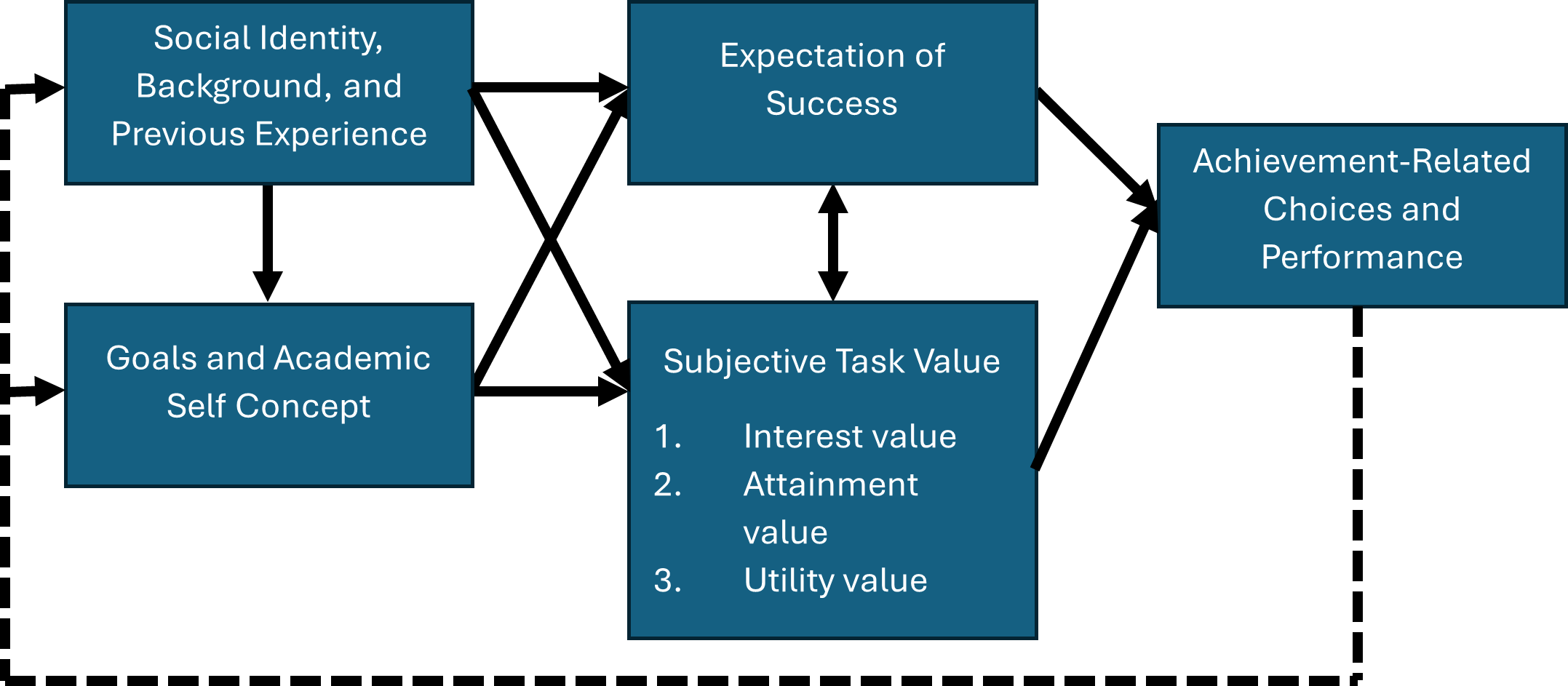 _
_
Note: This figure summarizes the main components of the SEVT described in Eccles & Wigfield, 2020.
_
Eccles and Wigfield (2020) define expectancies for success as “individuals’ beliefs about how well they will do on an upcoming task” (Eccles & Wigfield, 2020, p. 3). Your judgment about how well you will do on an assignment or assessment (like a quiz or exam) is determined by your social identity, background, previous experiences, your goals, and your academic self-concept. Whether you think you will do well on the learning task is not enough to motivate you, however. Motivation is also influenced by your unique view about how valuable it is for you to complete a given task.
Subjective Task Values (STV) are viewed differently by each individual learner. Overall value is determined by intrinsic value, attainment value, utility value, and cost. Intrinsic value is “the anticipated enjoyment one expects to gain from doing the task for purposes of making choices and as the enjoyment one gets when doing the task” (Eccles & Wigfield, 2020, p. 4). You might not think that a learning activity can be particularly enjoyable, but they can be! Utility value is “how well a particular task fits into an individual's present or future plans” (Eccles & Wigfield, 2020, p. 5), or a means to an end. Even though you may not realize it, every time you get started with homework, you are thinking to yourself, “How useful is this task? Will it help me reach any of my goals?” If the answer is that it is not useful and won’t help to get you where you want to go, you are much less likely to do the assignment. Attainment value is “the relative personal/identity-based importance attached by individuals to engage in various tasks or activities” (Eccles & Wigfield, 2020, p. 5). In other words, how much better will you feel about yourself by doing the learning activity well? When we weigh up the cost to benefit ratio of completing a learning task, we assess:
Effort cost – the perception of how much effort it will take to complete a task and whether it is worth doing so;
Opportunity cost- how much doing one task takes away from one’s ability or time to do other valued tasks; and
Emotional cost -the emotional or psychological costs of pursuing the task, particularly anticipated anxiety and the emotional and social costs of failure. (Eccles & Wigfield, 2020, p. 5)
It is important to note that all of these factors can be influenced by others within your social sphere: parents, friends, classmates, etc. For example, if you hear a friend talking about how much they enjoyed a class because of how much they learned, this might increase your intrinsic value, or interest, in taking the class yourself. You may also be subject to stereotype threat where thinking about negative societal expectations of your identity (e.g., girls are not good at math, people of color are not academically successful, etc.), can lead you to believe in these stereotypes, avoiding the learning task because of the emotional cost and low attainment value (Beilock et al., 2007; Steele, 1997).
One final note about motivation: mattering matters! What you are learning has to matter to you in some way. If there is no emotional connection to the content, such as curiosity or empathy, the information will probably not be remembered. The brain is too efficient to learn something that is not meaningful (Immordino-Yang, 2015). Emotional connections to course content can provide further task value.
How can AI help?
How can you use generative AI chatbots to help with your motivation? Let’s examine some of the components of the SEVT model.
Expectation of Success: You have an exam coming up. What are your expectations for success? It would be nice to have some verification of how well you know the content so you can be more accurate in your expectation for success. Unfortunately, we often over-estimate how well we know course content because we are just familiar with the content (Brown et al., 2014; Deslauriers et al., 2019). We might be able to recognize it, but really knowing it requires you to come up with the information on your own and apply it. You can use an AI chatbot to test your knowledge of the content. Take out your study guide, then ask ChatGPT, Bing, Gemini, or Claude to prepare you for the exam. Here’s an example.
AI Chatbot Example: Study for an Exam
Intrinsic Value: You’re in college on a football scholarship and economics is the last thing you want to learn. If you can’t find a reason for wanting to learn the course content, then you are going to struggle to stay motivated in the class. Maintaining your GPA to keep your scholarship might not be enough. Ask your favorite chatbot to give you a reason to learn economics. Adjusting the prompt and settings can really help you get a useful response. Check out this example:
AI Chatbot Example: Increase Interest in Course Content
Cost: Suppose you think of yourself as “not a math person” and are now thinking about the assignment for your stats class. Could you just plug the questions into Wolfram Alpha to get the answers and submit them? Sure. Would this help you learn the content? Absolutely not. But you’re weighing the costs of completing this assignment: the effort is probably more than it’s worth, it’s going to take way too much time that you could be spending on other assignments, and the emotional cost will be high, too—you hate math and know that the whole experience will be frustrating and you’re not sure you will be able to understand the assignment in the first place. Can generative AI help? Check out this example of using a chatbot as a companion tutor to help you through a stats assignment:
AI Chatbot Example: Personalized Stats Tutor
How will AI hinder?
Anything that interferes with the motivation cycle described above can potentially hinder your motivation for learning. You may also be surprised to know that if something is too easy, in other words has no cost associated with it, you will likely have no interest in the task either. If you let generative AI do an assignment for you rather than with you, you risk lowering your motivation for continuing to learn. As mentioned above, feeling successful with learning will increase your motivation to continue learning, but if you don’t give yourself an opportunity to be successful, you will miss out on this spark.
Topic Sources
Fensie, A. (2024). How to use AI to Help, Not Hinder, Your Learning. Introduction to AI and Ethics in Higher Education. https://edtechbooks.org/introduction_to_ai_and_ethics_in_higher_education/how_to_use_ai_to_help_not_hinder_your_learning
Topic Authors
Anne Fensie